
Quick Answer: For most people, the best time to visit Ireland is from May to September. May and June bring the most sunshine and up to 17 hours of daylight. July and August are the warmest months but also the busiest. If you want quieter roads and better value, go in April, May or September. Winter is mild but wet and dark, with only about 7.5 hours of daylight in December.
There is no bad month to come to Ireland, but each one gives you a different trip. We drive visitors around the country all year on our private chauffeur tours of Ireland, and the question we hear most before a booking is simple: when should we come? This guide answers it month by month, using 30 years of weather records, real daylight hours and the events that fill hotels.
When Is the Best Time to Visit Ireland?
It depends on what you want from the trip:
- Best weather: May to August. May and June are the sunniest months. July and August are the warmest.
- Best value and fewer crowds: April, May, September and early October.
- Longest days for sightseeing: May to July, when it stays bright until 10pm in the west.
- Festivals and atmosphere: March for St Patrick’s Day, July and August for the big summer festivals.
- Lowest prices and cosy pubs: November to February, if you can live with short, wet days.
If we had to pick one month, it would be May. The days are long, the weather is often at its best, and the summer crowds have not yet arrived. September comes a close second.
Ireland Weather by Month
Irish weather is mild all year. It rarely gets very hot or very cold, but it can change several times in one day. The table below uses the official 1991 to 2020 averages from Met Éireann for Shannon Airport in Co. Clare, on the west coast. Daylight hours are for the middle of each month.
| Month | Average high | Average low | Days with rain | Daylight |
|---|---|---|---|---|
| January | 9°C | 3°C | 17 | 8 hours |
| February | 9°C | 3°C | 14 | 10 hours |
| March | 11°C | 4°C | 13 | 12 hours |
| April | 13°C | 6°C | 11 | 14 hours |
| May | 16°C | 8°C | 12 | 15.5 hours |
| June | 18°C | 11°C | 11 | 17 hours |
| July | 20°C | 13°C | 14 | 16.5 hours |
| August | 19°C | 12°C | 14 | 15 hours |
| September | 18°C | 11°C | 13 | 13 hours |
| October | 14°C | 8°C | 15 | 10.5 hours |
| November | 11°C | 6°C | 17 | 9 hours |
| December | 9°C | 4°C | 17 | 7.5 hours |
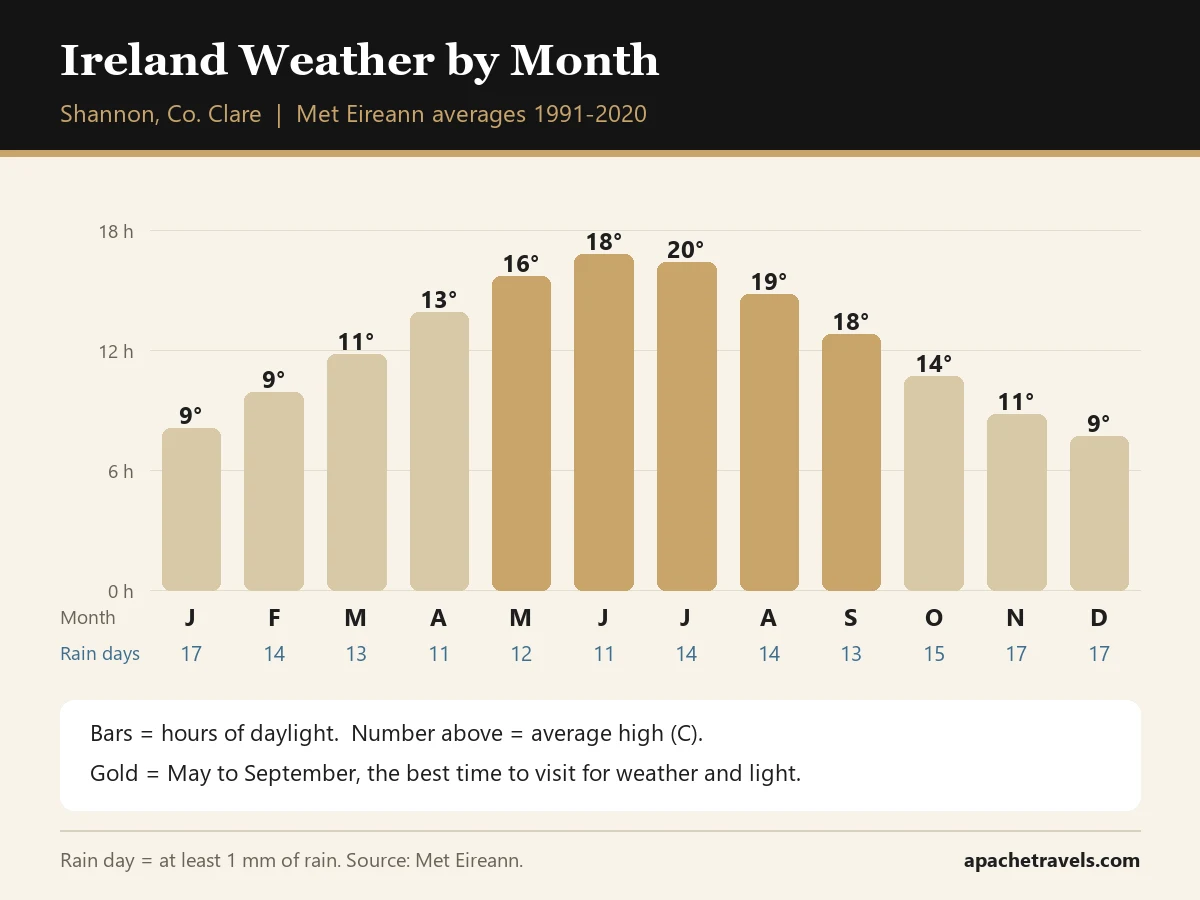
A “day with rain” means at least 1 mm fell at some point. On most of those days it is a shower or two, not a washout. The east is drier than the west. Dublin Airport gets about 770 mm of rain a year, while Shannon gets about 1,020 mm.
Ireland Month by Month
January
January is the quietest and one of the coldest months, with highs of around 9°C. Days are short, and the sun sets before 5pm. Snow is rare near the coast, but wind and rain from Atlantic storms are common. In return, you get low hotel rates and empty museums.
February
Still wintry, but the light is coming back, with about 10 hours of daylight by mid-month. Ireland marks St Brigid’s Day with a bank holiday on the first Monday of February. Six Nations rugby matches in Dublin can fill city hotels on match weekends.
March
March is all about St Patrick’s Day on 17 March. Every town has a parade, and Dublin runs a festival over several days. Book early if you want to be in Dublin that week. The weather is still cool and showery, and the clocks go forward on the last Sunday of the month, giving you bright evenings.
April
Spring arrives. Fields fill with lambs, the gorse turns the hills yellow, and April has fewer rain days than any month before it. Easter brings a busy weekend and school holidays, but the rest of the month is calm. It is one of the quieter months to visit Ireland while still getting 14 hours of light.
May
Our favourite month. May is one of the two sunniest months in Ireland, with highs around 16°C and over 15 hours of daylight. Gardens are in full bloom, and boat trips to Skellig Michael off Co. Kerry usually start in mid-May, weather permitting. The first Monday of May is a bank holiday, so book that weekend ahead.
June
June has the longest days of the year. Around 21 June the sun rises just after 5am and sets around 10pm on the west coast, and it never gets fully dark. Highs reach about 18°C. Dublin celebrates Bloomsday on 16 June in honour of James Joyce. Crowds start to build towards the end of the month, once Irish schools close.
July
July is the warmest month, with highs near 20°C, and the start of peak season. Irish families are on holiday, and visitors from abroad arrive in big numbers. It is a great month for festivals: the Willie Clancy Summer School of traditional music in Miltown Malbay, Co. Clare, the Galway International Arts Festival and, in the last week of the month, the Galway Races. The All-Ireland hurling and football finals are also played at Croke Park in July.
August
Almost as warm as July and just as busy. Famous attractions like the Cliffs of Moher and the Ring of Kerry are at their most crowded, so arrive early in the day. August events include Puck Fair in Killorglin, Co. Kerry (10 to 12 August), the Rose of Tralee and the Fleadh Cheoil, the country’s biggest traditional music festival, which moves to a different town each year. The first Monday of August is a bank holiday.
September
Once Irish schools go back at the start of September, roads and hotels get noticeably quieter. The weather is often settled, with highs around 18°C, and the sea is still warm from the summer. In Co. Clare, the Lisdoonvarna Matchmaking Festival runs through the month. If you cannot travel in May, September is the next best choice.
October
Autumn colour arrives, and the days get shorter fast. Highs drop to around 14°C, and Atlantic storms become more likely. The clocks go back on the last Sunday of October, and the next day is a bank holiday. That weekend is also when Cork hosts its Jazz Festival. Halloween has its roots in the old Irish festival of Samhain, so it is a fun time to be here.
November
November is one of the wettest and darkest months, with about 9 hours of daylight. It is also the quietest time for tourism, so you will often have castles and walks to yourself. During the month, Christmas markets in Ireland open in cities such as Galway and Belfast.
December
At Shannon, December is the wettest month, and the sun sets around 4.20pm. But the towns are lit up for Christmas, and the pubs are at their cosiest. On the mornings around the winter solstice, the rising sun lights up the passage tomb at Newgrange in Co. Meath, a sight that is over 5,000 years old. Note that most attractions, shops and pubs close on Christmas Day, and many also close on St Stephen’s Day, 26 December.
Daylight Hours in Ireland
Ireland sits far north, about level with Calgary in Canada, so the length of the day changes a lot through the year. This matters more than most visitors expect.
- Midsummer (around 21 June): nearly 17 hours of daylight. On the west coast it is still light enough to walk after 10.30pm.
- Midwinter (around 21 December): about 7.5 hours of daylight. The sun rises around 8.45am and sets around 4.20pm.
- Spring and autumn: about 12 hours of daylight around the equinoxes in March and September.
In summer you can fit two or three big sights into a day and still be at dinner in daylight. In winter, plan one main sight a day, and try not to drive on narrow country roads after dark. Our guide to driving in Ireland as a tourist explains what those roads are really like.
Ireland in Winter: What It Is Really Like
Ireland in winter is not for everyone, but plenty of visitors love it. Here is an honest picture:
- It is mild. Daytime highs are usually 8 to 10°C. Frost happens, but snow at low levels is rare, especially near the west coast.
- It is wet and windy. Most named storms hit between October and March. Bad weather can close coastal walks and cancel ferries at short notice.
- It is dark. With 7 to 9 hours of daylight, you have to plan your days.
- Some places close. Island boat trips stop, and some smaller attractions, cafés and family-run B&Bs close or cut their hours between November and March. Check before you go.
- It is quiet and good value. Hotels cost less, there are no queues, and a turf fire in a country pub feels well earned.
The big sights stay open. The Cliffs of Moher are open all year, apart from 24 to 26 December, though they may close in extreme weather. If you are flying into Shannon, our guide on getting from Shannon Airport to the Cliffs of Moher covers every way to get there.
The Quieter Months to Visit Ireland
If you want good weather without the crowds, aim for the shoulder seasons:
- April and May: long days, spring colour and fewer people. Avoid Easter week and the May bank holiday weekend if you want it really quiet.
- September and early October: settled weather, a warm sea and no school holiday crowds.
Whatever month you choose, the busiest times are Irish school holidays and bank holiday weekends. Irish primary schools are off in July and August, and secondary schools from early June. There are also short mid-term breaks in mid-February and at the end of October.
Bank Holidays in Ireland
On these days, hotels fill up, and some shops and offices close. In Northern Ireland the dates are different.
| Bank holiday | When |
|---|---|
| New Year’s Day | 1 January |
| St Brigid’s Day | First Monday in February (or 1 February if that is a Friday) |
| St Patrick’s Day | 17 March |
| Easter Monday | March or April |
| May bank holiday | First Monday in May |
| June bank holiday | First Monday in June |
| August bank holiday | First Monday in August |
| October bank holiday | Last Monday in October |
| Christmas Day | 25 December |
| St Stephen’s Day | 26 December |
For the official list, see Citizens Information.
What to Pack for Any Month
The secret to Irish weather is layers. Even in summer, bring:
- A proper waterproof jacket with a hood. An umbrella is not much use in coastal wind.
- A warm jumper or fleece, even in July.
- Comfortable shoes that can handle wet grass and muddy paths.
- Sunglasses and sun cream. The Irish sun can surprise you, especially in May and June.
Plan Your Trip Around the Season
The best trips match the plan to the season. In summer, start early to beat the coaches at the big sights. In winter, keep driving days short and finish before dark. A local driver handles both for you. They know which roads close in storms, where the crowds will be, and when to stop for the best light.
Our tour of Ireland service runs all year, and we can meet you off your flight with a Shannon Airport transfer or a Dublin Airport transfer. Not sure which airport suits your route? Read Shannon vs Dublin Airport for the west of Ireland. When you are ready, book your chauffeur online or contact our team to plan your dates.
Frequently Asked Questions
What is the best month to visit Ireland?
May is the best all-round month. It is one of the sunniest, has over 15 hours of daylight and is quieter than summer. September is a close second.
What is the rainiest month in Ireland?
On the west coast, November, December and January are the wettest, with rain on around 17 days of each month at Shannon. April to June are usually the driest months.
Is Ireland worth visiting in winter?
Yes, if you plan for short days and changeable weather. You get lower prices, quiet attractions and Christmas atmosphere. Keep your plans flexible in case of storms.
When is the cheapest time to visit Ireland?
November to February, apart from Christmas, New Year and big rugby weekends in Dublin. Flights and hotels are usually at their lowest then.
Does it snow in Ireland?
Not often. Snow falls on the mountains most winters, but it rarely settles in towns, especially on the west coast. A few days of snow or frost each winter is normal.
How many hours of daylight does Ireland get in summer?
Around the longest day in June, Ireland gets nearly 17 hours of daylight. On the west coast it stays bright until after 10pm.
When is the busiest time to visit Ireland?
July and August, plus St Patrick’s Day week and bank holiday weekends. Book hotels, hire cars and drivers early for these dates.
About This Guide
This guide was written by the Apache Travels team in Shannon, Co. Clare. We drive visitors around Ireland in every season. The weather figures are the official 1991 to 2020 averages for Shannon Airport and Dublin Airport from Met Éireann. Daylight hours are calculated for Shannon. Holiday dates were checked against Citizens Information, and event details were checked with Discover Ireland in October 2026. Event dates change from year to year, so always check the organiser’s website before you book.