
Quick Answer: In Ireland you drive on the left, and speed limits are in kilometres per hour. Most visitors can drive on their home licence for up to 12 months. The drink-driving limit is low, and the M50 toll around Dublin has no barrier, so you must pay online by 8pm the next day. Motorways are easy to drive. Narrow country roads and tiredness after a long flight cause most of the trouble.
Every year thousands of visitors hire a car at Shannon or Dublin Airport and head for the Wild Atlantic Way. Most have a great time. The ones who struggle usually did not know a few simple rules before they set off. This guide covers what you need to know, in plain terms.
Can I Drive in Ireland on My Licence?
In most cases, yes.
- EU and EEA licences: valid in Ireland for as long as the licence is valid.
- US, Canadian and many other licences: visitors can drive on them for up to 12 months.
- UK licences: accepted for visitors.
An International Driving Permit is not usually required for a visitor with a licence in English, but some hire companies ask for one, so check before you book. Hire companies also set their own age limits. Drivers under 25 often pay extra, and some firms have an upper age limit too. For the official rules, see Citizens Information.
Driving on the Left: What Changes
If you normally drive on the right, the first hour is the hardest. Here is what to expect:
- The driver sits on the right-hand side of the car.
- In a manual car, you change gear with your left hand. The pedals are in the same order as at home.
- At junctions, look right first.
- On a two-lane road, keep left. Overtake on the right.
- Most hire cars in Ireland are manual. If you want an automatic, book it early, as they can run out in summer.
A simple trick many visitors use: keep your body, as the driver, near the centre line of the road.
Speed Limits in Ireland
Speed limits in the Republic of Ireland are in kilometres per hour (km/h). The default limits are:
| Road type | Letter | Sign colour | Default limit |
|---|---|---|---|
| Motorway | M | Blue | 120 km/h |
| National road | N | Green | 100 km/h |
| Regional road | R | White | 80 km/h |
| Rural local road | L | White | 60 km/h |
| Towns and villages | – | – | 50 km/h (30 km/h in some areas) |
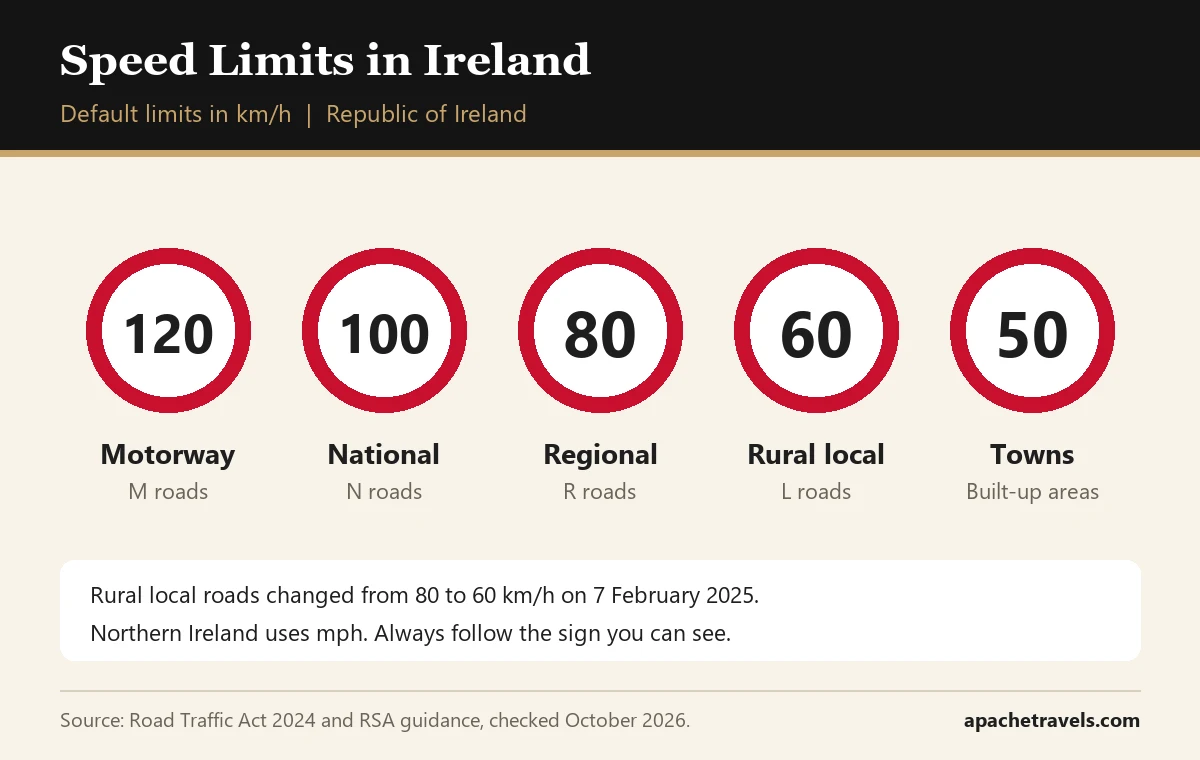
Some of these have changed recently. The limit on rural local roads dropped from 80 km/h to 60 km/h on 7 February 2025. A cut on national secondary roads from 100 km/h to 80 km/h has been planned but was not in force at the time of writing. Many towns are also bringing in 30 km/h zones. The posted sign always wins, so watch for it.
Speed cameras are common. Marked GoSafe vans check speeds across the country for the Gardaí, the Irish police.
One more thing to know: Northern Ireland uses miles per hour. If you drive north across the border, the signs switch to mph, and there is no checkpoint to remind you.
How to Use a Roundabout in Ireland
Ireland has a lot of roundabouts, and they confuse many visitors. The rules are simple:
- Go around the roundabout clockwise (to the left).
- Give way to traffic coming from your right, which is already on the roundabout.
- Use your left indicator before your exit.
- For larger roundabouts, check the sign before you arrive and pick the right lane early.
Tolls: The M50 Catches Visitors Out
Most toll roads in Ireland have a booth with a barrier, where you pay by card or cash. The M50 around Dublin is different. It has no barrier and no booth. Cameras read your number plate between junction 6 and junction 7.
If you drive this section, you must pay by 8pm the next day, online at eFlow.ie or in a shop with a Payzone outlet. If you miss the deadline, a late fee is added, and it grows if you keep ignoring it. Ask your hire company how they handle tolls, as some add them to your bill.
Our guide to getting from Dublin Airport to Galway explains when the M50 is on your route.
Drink-Driving Laws
Ireland is strict on drink-driving. The legal limit is 50 mg of alcohol per 100 ml of blood for most drivers. For learner, newly qualified and professional drivers, it is only 20 mg.
For most people, even one drink can bring you close to the limit. The Gardaí run checkpoints on all kinds of roads, at any time of day. The safe rule is simple: if you are driving, do not drink at all.
Other Road Rules to Know
- Phones: it is illegal to hold a mobile phone while driving.
- Seat belts: everyone in the car must wear one.
- Children: a child under 150 cm or under 36 kg must use the right child seat. Book these with your hire car.
- Yellow lines: a double yellow line at the side of the road means no parking at any time.
- Emergency number: call 112 or 999.
What Country Roads Are Really Like
This is the part guidebooks often skip. Many of the most beautiful places in Ireland, like the Ring of Kerry, Connemara or the coast of Clare, are reached by narrow roads.
- Some roads are only wide enough for one car, with stone walls or hedges on both sides.
- You will meet tractors, cyclists, sheep and tour coaches.
- If a car comes the other way, slow down and pull into the nearest gap. Locals will often give a small wave.
- Driving times on a map can be too short. Add extra time on rural routes.
- The weather changes fast. Rain and fog can make a road far harder to drive than it looked in sunshine. Check our month by month guide to Irish weather before you plan your route.
Petrol, Diesel and Fuel Stations
At Irish fuel stations, the green pump is petrol (unleaded) and the black pump is diesel. Putting the wrong fuel in a hire car is a common and costly mistake, so check the cap or the paperwork before you fill up. Fuel stations are easy to find on main roads, but they get further apart in remote areas. Fill up before heading into the hills.
Driving into Northern Ireland
You can drive across the border freely. There are no border posts. Before you go, tell your hire company, as some charge a fee for taking the car into Northern Ireland, and check that your insurance covers it. Remember that speed limits switch to mph and prices are in pounds sterling. If you are flying into the north instead, see our Belfast airport transfers.
Is Driving in Ireland Hard?
For most confident drivers, no. Motorways and main roads are well signposted and easy to follow. What makes it hard is the mix of three things on the same day:
- Driving on the left for the first time
- Narrow, winding country roads
- Tiredness after an overnight flight
That third one matters most. Plenty of visitors land at 6am, pick up a hire car and drive for three hours on no sleep. If you can, avoid driving on the day you land. A pre-booked Shannon Airport transfer or Dublin Airport transfer gets you to your hotel safely, and you can collect a hire car the next morning.

When a Private Driver Makes More Sense
Driving yourself is not always the best choice. A chauffeur is often the better option when:
- You are travelling as a family or group and want everyone to enjoy the views.
- You want to visit pubs or distilleries without worrying about drink-driving.
- You are on a golf trip with clubs and luggage. Our golf chauffeur service is built for this.
- You are not comfortable driving on the left or on narrow roads.
- You want a local who knows the roads, the shortcuts and the best stops.
A private chauffeur tour of Ireland gives you the freedom of a car without the stress. Our guide to chauffeur services in Ireland explains what to look for when you compare companies.
Frequently Asked Questions
Which side of the road do they drive on in Ireland?
Ireland drives on the left, both in the Republic and in Northern Ireland.
Can Americans drive in Ireland?
Yes. Visitors can drive in Ireland on a valid US licence for up to 12 months. Check your hire company’s own rules on age and documents.
What is the speed limit on Irish motorways?
The default limit on motorways is 120 km/h. National roads are 100 km/h, regional roads 80 km/h, rural local roads 60 km/h, and towns 50 km/h unless a sign says otherwise.
How do I pay the M50 toll in a hire car?
Ask your hire company first. If you are responsible for it, pay online at eFlow.ie or at a Payzone outlet by 8pm the day after your trip.
Is it safe to drive in Ireland?
Yes, if you take your time. Plan shorter driving days, avoid driving when tired, and slow down on narrow rural roads.
Should I hire an automatic car in Ireland?
If you do not drive a manual car at home, yes. Book it early, as automatics are in shorter supply and usually cost more.
Do I need a car to see the Cliffs of Moher?
No, but it helps. There is no direct bus from Shannon Airport. See our guide on how to get from Shannon Airport to the Cliffs of Moher for every option.
About This Guide
This guide was written by the Apache Travels team in Shannon, Co. Clare, where we drive visitors on Irish roads. The rules were checked in October 2026 against the Road Safety Authority, Citizens Information and Transport Infrastructure Ireland. Road rules can change, so always check the latest official guidance before you travel.