
Quick Answer: To plan corporate event transport in Ireland, start with the event timetable, then list every group that needs to travel: delegates, speakers, VIP guests and staff. Match each group to a pick-up point, a drop-off point and a time window, add a buffer for traffic and late flights, and choose vehicles by group size. Confirm the plan in writing two to four weeks before the event. If you would rather hand the planning and the drivers to one team, our corporate chauffeur service covers the full schedule, from arrivals to departures.
Event transport looks simple until the day arrives. A conference with 120 delegates, six speakers and a handful of VIP guests needs more than a few cars. It needs a timetable that works with the agenda, vehicles that fit each group, and one person who can make changes when a flight lands early or a session runs late. This guide walks through the planning steps in the order we use them for clients across Dublin, Shannon, Galway and the rest of the country.
What Counts as Corporate Event Transport
Corporate event transport covers every journey linked to a business event: arrivals from airports and train stations, transfers between hotels and the venue, shuttles during the event, and departures at the end. It also includes the guests who need a more private service, such as speakers, board members and clients.
Most events combine three types of travel. A scheduled shuttle moves a large group on a loop. Individual transfers take one or two people directly from A to B. A chauffeur service looks after the guests who need a driver for the whole visit. Good planning uses all three, and each one is set up differently. If your travellers are airline crew rather than event guests, the rules change, and our guide to choosing an airline crew transport partner covers that side.
Step 1: List Every Group and Its Needs
Start with a simple list of who is travelling, where they are coming from and when they need to be there. Group the guests by need, because one vehicle rarely suits everyone. The table below is a typical starting point:
| Group | Typical need | Suggested vehicle |
|---|---|---|
| Delegates | Group arrivals and hotel-to-venue shuttles | Minibus or Sprinter for groups of 8 or more |
| Speakers and panel guests | Private, on time, with a named driver | Executive saloon or 7-seater V-Class |
| VIP guests | Discreet service, meet and greet, flexible timings | S-Class or V-Class with a senior chauffeur |
| Event staff and AV crew | Equipment space and early starts | Sprinter with luggage capacity |
Step 2: Map Arrivals and Departures
Most delegates arrive by air, so the flight schedule drives the whole plan. Collect every arrival time from the guest list, and sort them by airport. Dublin Airport handles the most international arrivals, while Shannon and Knock suit groups heading to the west, and Belfast and Cork serve their own regions. Our guides to Dublin Airport transfers and Shannon Airport transfers explain the routes for each.
Leave a buffer between the landing time and the pick-up. Allow for passport control, baggage and the walk to the pick-up point, and for traffic on the motorway into the city at peak hours. A pick-up window of 30 to 45 minutes after landing is a sensible default for groups. For VIP guests, a meet and greet inside the arrivals hall removes the wait entirely.
Step 3: Plan Delegate Transfers and the Conference Shuttle
For a large group, a shuttle is usually more practical than separate cars. Set the loop from the main hotels to the venue, then calculate how many vehicles you need to keep the gap between departures short. A departure every 15 to 20 minutes is comfortable for most conference days, and it means nobody waits long in the cold.
Plan the shuttle around the agenda, not only the arrivals. Add extra runs before the opening session, at the lunch break and after the closing talk, when most delegates move at the same time. Ask the venue for its loading point and any access restrictions, especially in city centre venues where vehicles need a set stopping area.
Print the shuttle times for each hotel and send them to the delegates in advance. A short timetable with the pick-up point and the vehicle contact number reduces the number of calls on the day.
Step 4: Arrange VIP Guest Transport
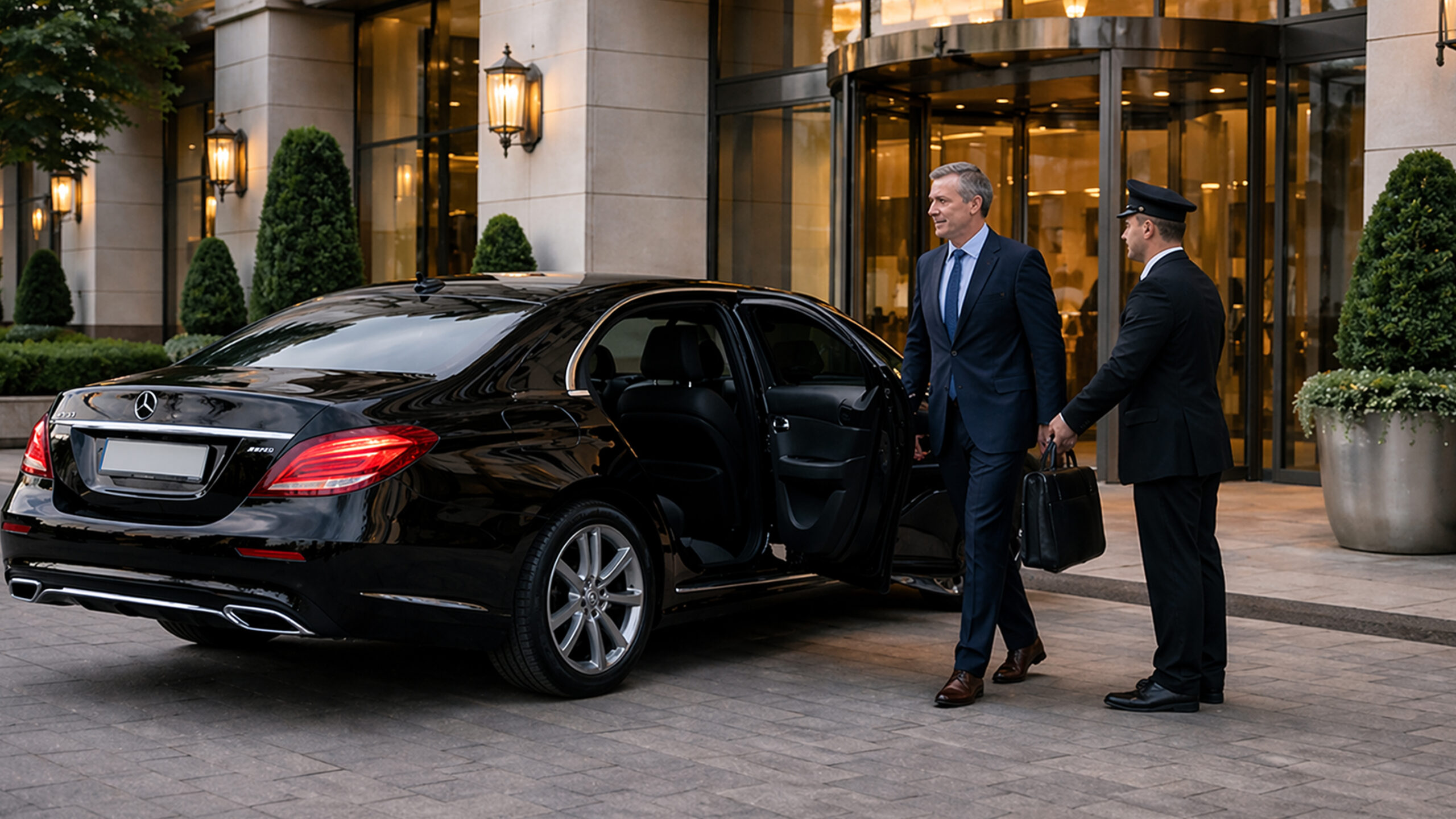
VIP guests need a different level of care. They usually want one driver for their whole visit, a vehicle that suits a private conversation, and flexible timings when meetings run over. A saloon such as the S-Class suits one or two guests, and the 7-seater V-Class works well for a small group that wants to travel together.
Share the VIP names, their schedule and any dietary or accessibility needs with the driver team before the event. Agree who meets each guest, what the guest should expect on arrival and who makes the call if a meeting moves. Our luxury chauffeur fleet lists the vehicles we run, and our guide to the luxury chauffeur services in Ireland explains what to expect from a private driver.
Step 5: Write the Event Transport Schedule
Turn the plan into one schedule that every team member can read. A good schedule lists the time, the vehicle, the pick-up point, the passengers and the contact for each run. Keep one master copy and send the driver team the same version.
- Confirm the event dates, venue address and loading point for vehicles.
- Collect the arrival and departure times for every guest, sorted by airport and hotel.
- Assign vehicles to groups, with a spare vehicle or driver for late changes.
- Build the shuttle loop and the individual transfers into one timetable with buffers.
- Add the departure runs, including the times for hotel checkout and the last flights.
- Share the schedule with the venue, the hotels and the driver team, and name one contact for changes.
The example below shows how a one-day conference might look. Treat the times as a template and adjust them for your event:
| Time | Run | Vehicles | Notes |
|---|---|---|---|
| 07:30 | Airport pick-up, speakers | 1 V-Class | Meet and greet at arrivals |
| 08:00 | Hotel to venue shuttle, first wave | 2 Sprinters | Runs every 20 minutes until 09:00 |
| 09:30 | VIP guest transfer to venue | 1 S-Class | Driver waits for the guest |
| 12:30 | Lunch break shuttle | 2 Sprinters | Return run to the hotels |
| 17:00 | Venue to hotel, closing runs | 2 Sprinters | Hold one vehicle for late changes |
| 18:30 | Evening dinner transfers | 1 V-Class | Confirm the restaurant pick-up time |
Step 6: Agree the Details in Writing
Most transport problems on event days come from details nobody confirmed. Before the event, agree these points in writing:
- Vehicle type and capacity: the number of passengers, luggage allowance and any wheelchair access.
- Pick-up and drop-off points: exact addresses, with the venue loading point and any access restrictions.
- Named contacts: one person for the event team and one for the driver team, with mobile numbers for the day.
- Waiting time: how long a driver waits for a late flight or a guest who is delayed.
- Changes and cancellations: how far in advance changes can be made and what applies to late cancellations.
- Backup plan: what happens if a vehicle breaks down, and how quickly a replacement can arrive.
For a fuller picture of how we run these bookings, see our corporate transport partner page, or reserve a service online to start a quote.
Choosing Vehicles for Groups
The right vehicle keeps the schedule on track. Small groups of two or three guests travel comfortably in an executive saloon. A 7-seater V-Class is a good choice for a team of four to six, or a small VIP party with luggage. For larger delegations, a Mercedes Sprinter gives you enough seats and luggage space to run a shuttle loop with fewer vehicles.
Ask for more capacity than you think you need. A full coach with no room for luggage slows the boarding, and a spare seat on the way back costs very little. If the event includes exhibition stands or AV equipment, book a vehicle with enough space for the boxes as well as the passengers.
Venues and Road Conditions in Ireland
Irish venues vary a lot. Dublin city centre and the docklands can see heavy traffic at rush hour, and some streets near the main venues have restricted access. Shannon and Galway are smaller, which makes shuttle loops simpler, but parking near the venue can be limited on busy days. In winter, daylight is short, so an early start can mean dark roads for part of the journey. Build extra time into the first and last runs, and check the route on the morning of the event.
If the event runs over several days, plan the routes once and then review them after the first day. Delegates often change their habits after the first run, and the second day usually needs fewer vehicles or a different loop.
Frequently Asked Questions
How far in advance should I book corporate event transport?
Book as soon as the guest list and venue are confirmed. For a large event, two to three months ahead gives you the best choice of vehicles. For a smaller event, four to six weeks is usually enough, but peak months need earlier planning.
What is the difference between a conference shuttle and delegate transfers?
A conference shuttle runs on a fixed loop between the hotels and the venue, usually at set times. Delegate transfers are individual or small group journeys, booked for a specific arrival or departure. Most events use both.
Do I need a separate plan for VIP guests?
Yes. VIP guests need a named driver, flexible timings and a higher level of discretion. Keep them on a separate schedule from the shuttle, so a delay for one guest does not affect the whole group.
Can one company handle airport arrivals and event shuttles?
Yes, and it usually makes the plan simpler. One team can track flights, manage the shuttle timetable and handle changes on the day, so your event team only needs to deal with one contact.
About This Guide
This guide was written by the Apache Travels team in Shannon, Co. Clare. We plan and run transport for corporate groups, conferences and VIP visitors across Ireland. Journey times and vehicle capacities are approximate and depend on traffic, the event layout and the vehicle chosen. For event dates and venue information, check the official event and venue websites, and for general visitor information see Discover Ireland.