
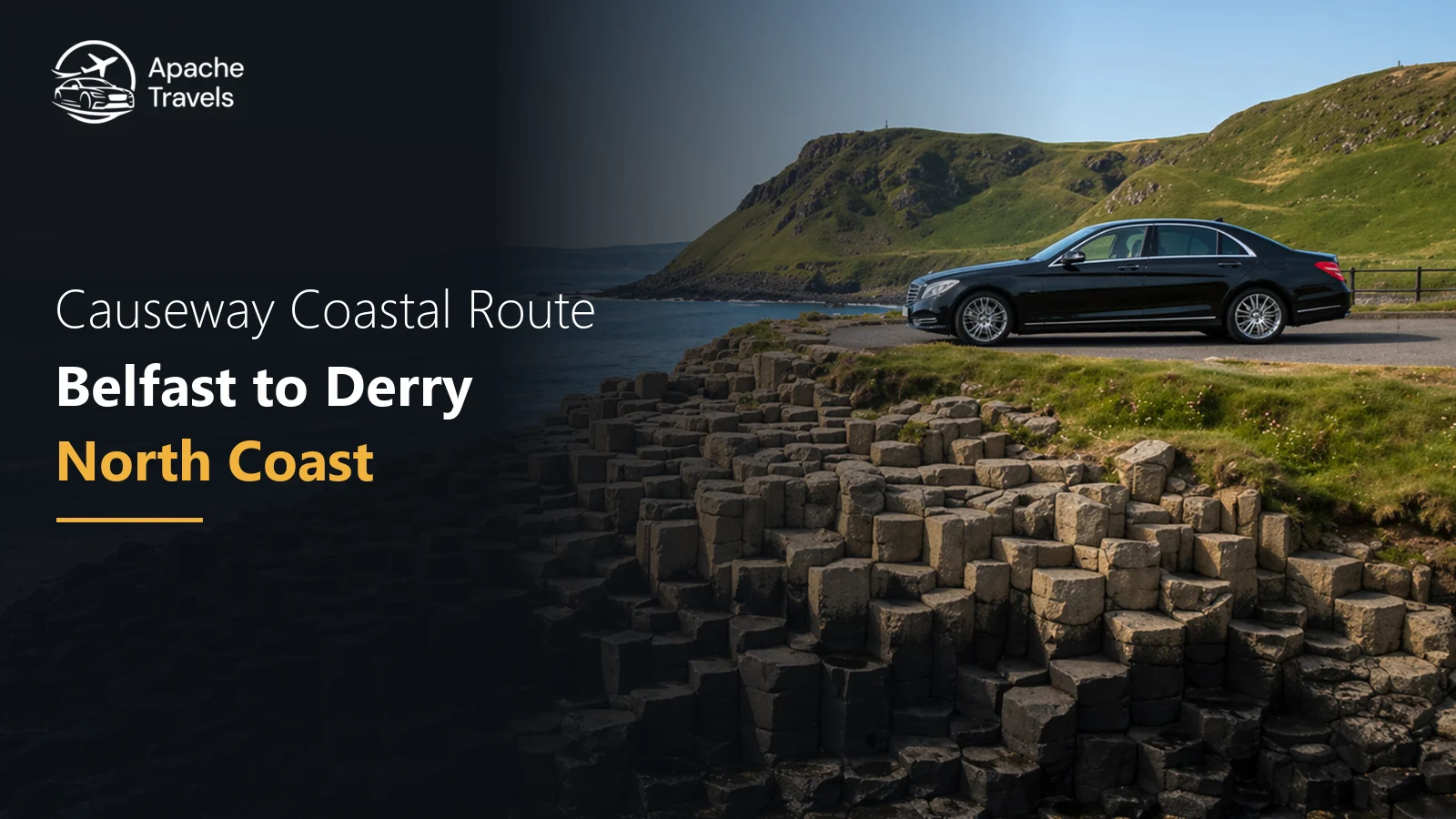
Quick Answer: The Causeway Coastal Route is the scenic road along Northern Ireland’s north coast, from Belfast to Derry. Its highlights include the Giant’s Causeway, the Carrick-a-Rede rope bridge and the Dark Hedges. Allow two days at a relaxed pace and use a car. Visitors arriving in Belfast can start with transfers from Belfast Airport.
The Causeway Coastal Route is one of the most scenic drives in the British Isles, with sea cliffs, green headlands, castle ruins and small harbour towns all within a short distance of each other. Because the route follows the coast closely, it is best planned by stop rather than by mileage. This guide sets out the main stops, how long to allow, and the practical points that visitors from the Republic of Ireland and overseas often miss.
The Causeway Coastal Route at a Glance
The route runs from Belfast along the Antrim coast to Ballycastle, then west past Portrush and Portstewart to Derry, also known as Londonderry. It is a coast road rather than a motorway, so the pace is slow and the views change constantly. Plan for stops, not for speed, and expect the drive to take much longer than the map suggests.
- Belfast to Carrickfergus and Larne for the first coastal views and an easy start from the city.
- Ballycastle and Rathlin Island for harbour life and boats to the island in season.
- The Giant’s Causeway and Bushmills for the main attraction and a whiskey stop nearby.
- The Dark Hedges for the tree-lined road made famous by television.
- Portrush and Portstewart for beaches, golf and seaside towns.
- Derry for the city walls and the western end of the route.
The Giant’s Causeway: The Route’s Main Attraction
The Giant’s Causeway is a field of interlocking basalt columns on the coast, formed by ancient volcanic activity. It is a UNESCO World Heritage Site, and the columns can be walked on from the visitor centre down to the sea. The walk is uneven and steep in places, so comfortable shoes are essential, especially after rain. Details of the site are on the Giant’s Causeway page, and opening arrangements should be checked on the day with the site operator.
Most visitors arrive in the morning, when the car park and paths are quieter. The visitor centre has exhibits and a shop, and the walk down to the columns is the best part of the visit. Allow time for the climb back up, which is the harder half of the walk for many people.
Carrick-a-Rede Rope Bridge and the Coast Between Stops
The Carrick-a-Rede rope bridge crosses a narrow gap between the mainland and a small island, high above the water. It was originally built by salmon fishermen, and today it is a visitor attraction run by the National Trust. The bridge can close in high winds, so check the opening status before you travel, and do not plan the whole day around it. The Carrick-a-Rede rope bridge page gives background on its history.
Between the main stops, the coast road itself is the attraction. Pull into the lay-bys to look at the cliffs and the sea, and allow time for the small harbour villages, which are easy to miss if you drive straight through.
The Dark Hedges and Bushmills
The Dark Hedges is an avenue of old beech trees along a country lane near Ballymoney. The trees were planted in the 18th century and now form an arch over the road. The lane became well known to a worldwide audience through television filming, so expect other visitors, and aim for an early or late visit when the road is quieter. Give the lane a slow drive, as it is narrow and used by local traffic.
Bushmills is the village closest to the Giant’s Causeway and is home to the Old Bushmills Distillery, which offers tours. It is a good place for a lunch stop between the Causeway and the north coast. The Old Bushmills Distillery page has details of the distillery and its history.
Sample Plans for One and Two Days
Two days gives you time to stop properly. One long day is possible, but it means driving more and stopping less. The table below shows how the main stops can be split, with the time of day each one suits best.
| Stop | Best for | Practical note |
|---|---|---|
| Belfast start | Leaving the city early | Pick up the car in the city or at the airport before the morning peak |
| Carrickfergus and Larne | A short castle and harbour stop | Useful for a first break on the coast road |
| Ballycastle and Rathlin | Harbour life and island boats | Boat times are seasonal, so check before you plan around them |
| Giant’s Causeway and Bushmills | The main attraction and a lunch stop | Go early to avoid the busiest hours |
| Carrick-a-Rede rope bridge | A coastal crossing with sea views | Check wind closures and book ahead if the site requires it |
| Dark Hedges | A short, scenic lane | Visit early or late, and drive slowly |
| Portrush and Portstewart | Beaches, golf and seaside towns | Good for an evening stop or an overnight base |
| Derry | City walls and the route’s western end | Allow a full afternoon, or an overnight stay |
Derry is the natural end point, and its city walls are a short walk from the centre. Many visitors use it as the last night before heading south into the Republic, or as the start of a longer tour of the north west. If you are driving on to Donegal, allow extra time, because the roads are slower and the views are worth stopping for.
For a two day plan, stay overnight on the north coast, such as in Portrush or Ballycastle, and split the route at the Causeway. For a relaxed pace, add an extra night in Derry before heading back or onward into the Republic of Ireland.
Practical Points Before You Drive
Northern Ireland is part of the United Kingdom, so the rules and the currency are different from the rest of the island. Several points catch visitors out.
- Speed limits are in miles per hour, and road signs show distances in miles. Check the limit on every road.
- Drive on the left, and take extra care at roundabouts and on narrow coast roads.
- Pounds sterling are used in Northern Ireland, so have a card or some cash in pounds before you cross from the Republic.
- Fuel is priced in litres but sold in pounds, so compare prices with the signs before you fill up.
- Mobile signal can drop on the cliff roads, so download maps and attractions details before you leave.
- Weather changes fast, and the coast is exposed to wind, so bring layers and waterproofs.
Public transport along the coast is possible, with trains from Belfast to Portrush and buses on the coast road, but service levels vary by season and day of the week. Check the current timetables with Translink before you rely on them.
Related guides: Northern Ireland Golf Trip and Driving in Ireland as a Tourist.
Frequently asked questions
How many days do you need for the Causeway Coastal Route?
Two days is a comfortable plan. It gives you a night on the north coast, time at the Giant’s Causeway, and a stop in Derry or Portrush. A single day covers the main sights but leaves little time for walks, meals or photos.
Do you need a car for the Causeway Coastal Route?
A car gives you the most freedom, because you can stop wherever the views are good. Public transport can reach the main stops, but timetables are limited outside the busier months, so a car or a planned tour is the easier option for most visitors.
Is the Giant’s Causeway worth the walk?
Yes, for most visitors. The walk down to the columns is steep in places, but the view of the basalt field from the path is the main reason to visit. Check the current access options with the site operator before you go, especially if you have mobility needs.
When is the best time to drive the Causeway Coastal Route?
Late spring and early autumn are a good balance, with longer daylight and fewer crowds than the summer peak. Winter days are shorter and the coast is more exposed to wind, so check the forecast before a long drive, especially on the cliff roads.
Can you drive from Belfast to Derry in one day?
Yes, but it is a long day with many stops. Driving straight through is quick, while stopping at the Causeway, the Dark Hedges and the coast villages can take the whole day. Most visitors prefer to split the route over two days.
About This Guide: This guide was written by the Apache Travels team, which provides airline crew and passenger transport in the Shannon region and across Ireland. Stop details and opening arrangements can change, so check the site operators and the National Trust before you travel. Last updated 19 November 2026.